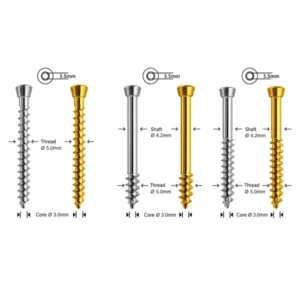
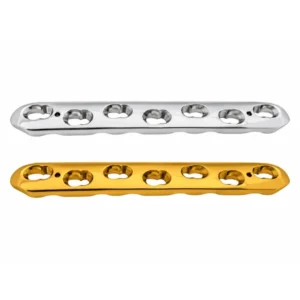
The Safety Lock Screw Ø5.0mm is designed for use with locking plates in fractures of large bones such as the tibia, femur and humerus. The threaded head locks into the plate, so stability does not depend on friction between plate and bone. This makes it well suited to osteoporotic, comminuted and unstable fractures, and supports bridge plating techniques that help preserve the blood supply around the fracture. The self-drilling version can reduce the need for pre-drilling, saving operating time, while the self-tapping version offers controlled insertion after drilling.
Key Features
- Ø5.0 mm thread with Ø4.4 mm core
- Fully threaded shaft
- Threaded locking head for fixed-angle stability
- Safety lock design to reduce back-out and toggling
- 3.5 mm hex recess for secure screwdriver engagement
- Self-tapping (fluted) and self-drilling (drill-point) tip options
- Compatible with 5.0 mm locking plates
- Available in stainless steel (silver) and anodized titanium (color-coded)
- Available in lengths from [14, 16, 18, 20, 22, 24, 26, 28, 30, 32, 34, 36, 38, 40, 45, 50, 55, 60, 65, 70, 75, 80, 85, 90 mm]
Technical Specifications
| Specification | Detail |
|---|---|
| Product Name | Safety Lock Screw |
| Thread Outer Diameter | Ø5.0 mm |
| Core Diameter | Ø4.4 mm |
| Drive | 3.5 mm Hex |
| Thread Type | Fully threaded |
| Head Type | Threaded locking head |
| Length Range | [e.g. 14 mm to 90 mm] |
| Length Increments | [e.g. 2 mm up to 40 mm; 5 mm above] |
| Material | Stainless Steel 316L ) / Titanium Ti-6Al-4V |
Indications / Applications
- Diaphyseal and metaphyseal fractures of the tibia, femur and humerus
- Fractures fixed with locking compression plates
- Osteoporotic bone fixation
- Comminuted and periprosthetic fractures
- Malunion and nonunion fixation
Advantages
- Fixed-angle stability for unstable fracture patterns
- Strong hold in osteoporotic and comminuted bone
- Lower risk of screw loosening and back-out
- Does not rely on plate-to-bone compression
- Self-drilling option can save operating time
- Color-coded titanium versions for easy identification
General Usage Notes
- Position the plate and fix it provisionally.
- Use the locking drill guide. For self-tapping screws, drill with the recommended drill bit. Self-drilling screws can be inserted directly, as per the manufacturer’s IFU.
- Measure the hole depth with a depth gauge.
- Insert the screw with the 3.5 mm hex screwdriver, using a torque-limiting handle if available, then tighten to final position.
- Do not use a locking screw to pull the plate to the bone. Use a conventional screw first if reduction is needed.
For single use only. Use only with compatible instruments and plates, and follow the manufacturer’s Instructions for Use (IFU). Do not reuse or re-sterilize.
Why Choose Us
- Precision-machined orthopedic implants
- Strict quality control at every stage
- Custom sizes, OEM and private label available on request
- Export-ready packaging
- Quick quotations and reliable delivery
Request a quote today for bulk orders, custom lengths or OEM supply.
FAQ
What is the Safety Lock Screw Ø5.0mm used for?
It is used with 5.0 mm locking plates for fracture fixation in bones such as the tibia, femur and humerus.
What is the difference between self-tapping and self-drilling versions?
Self-tapping screws are inserted into a pre-drilled hole and cut their own thread. Self-drilling screws have a drill-point tip that can create the hole as they are inserted.
What is the drive size?
The screw uses a 3.5 mm hex drive.
What is the difference between a locking screw and a standard screw?
A locking screw’s threaded head locks into the plate, creating a fixed-angle construct. A standard screw compresses the plate against the bone.
What materials are available?
Stainless steel 316L and titanium Ti-6Al-4V.